Short answer
For damp and mould, get a dehumidifier, and only after you have dealt with the cause. A dehumidifier takes moisture out of the air, which is what helps against condensation. An air purifier filters particles, including mould spores in the air, but it removes no moisture and leaves alone the damp that mould grows on. A 2-in-1 such as the Meaco Arete One does both jobs in one machine, though it cleans the air far more slowly than a dedicated purifier.
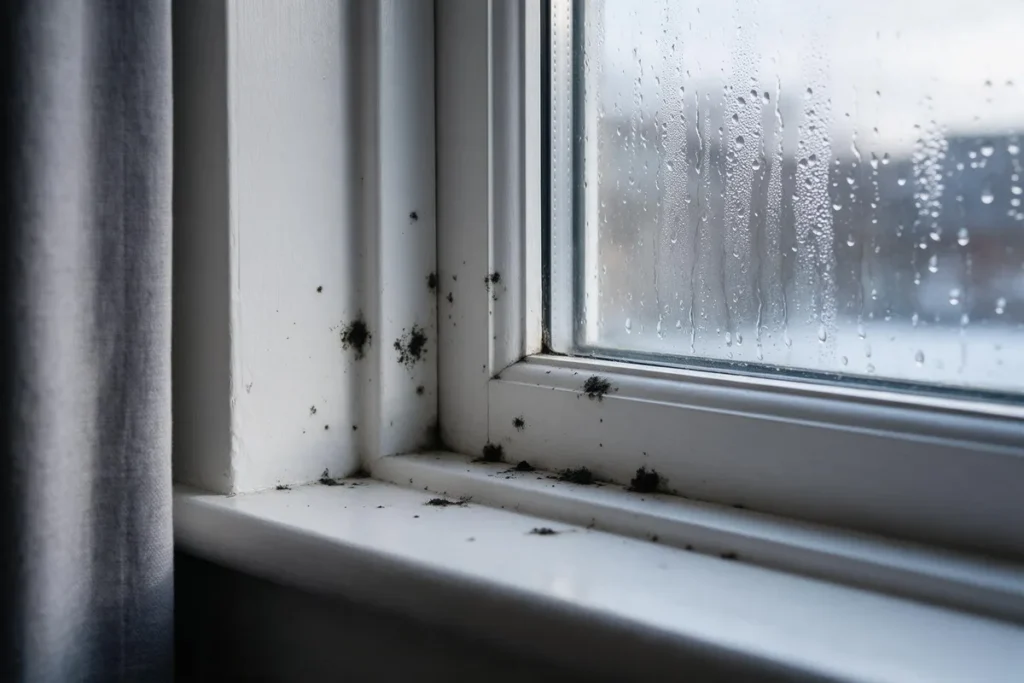
Black spots round a window frame, a musty wardrobe, washing that never quite dries: by the time most people ask this question, the mould is already there. UK guidance asks a different question first, where the moisture comes from, and neither machine answers that. The models mentioned below are in our purifier dehumidifiers and humidifiers and air purifiers comparisons.
Start with the cause: what UK damp guidance says
The government’s damp and mould guidance, from OHID, MHCLG and the UK Health Security Agency (updated April 2026), is written for landlords, but its advice fits any home. It names condensation from cooking, washing and drying laundry as one of the most common causes. The others are leaks, water getting in through walls or roofs (penetrating damp) and moisture rising from the ground (rising damp). Poor ventilation, heating and insulation add to all of them.
Its ventilation advice is short:
- Keep trickle vents open and clear.
- Make sure the kitchen and bathroom extractor fans work, and use them.
- Open windows while you cook or bathe, and for a while afterwards.
- Dry washing outdoors when you can.
Two points matter before you buy anything. Wiping mould off won’t stop it coming back: the guidance says the source of the moisture has to be found and fixed. And if you rent, that is your landlord’s legal responsibility. The guidance doesn’t mention dehumidifiers or air purifiers at all. Read the GOV.UK damp and mould guidance.
Who is most at risk: the guidance says damp and mould mainly affect the airways and lungs, and can also affect the eyes and skin. People with asthma, allergies or COPD, people with weakened immunity, children and older people are among those most at risk. If you are worried about symptoms, speak to a pharmacist or your GP.
Asthma + Lung UK’s advice on heat and humidity
Asthma + Lung UK adds heating: keep your home at 18°C or more in the colder months, and air rooms for a few minutes at a time. On machines it is brief: a dehumidifier can help prevent condensation, but it can also dry the air too much, so choose one that lets you set the humidity. Asthma + Lung UK on improving indoor air.
What a dehumidifier does
A dehumidifier lowers the amount of water vapour in the air. A compressor model, which is what every Meaco Arete is, draws room air over cold coils; the moisture condenses on them and drains into a tank or out through a hose. Drier air leaves less water to condense on cold windows and walls.
You set a target humidity. No UK health guidance we read gives a number; Meaco recommends 55% relative humidity and keeping a home between about 40 and 60%. The Arete One’s humidity setting steps from 40 to 70% in 5% stages, plus a continuous setting, and Meaco says there is little water left to collect once a room is below about 45%.
For a whole house, Meaco’s manual suggests somewhere central such as the landing, running all the time with internal doors open and outside doors and windows shut; for one damp room, that room with the door closed. Shut windows don’t mean no ventilation: air rooms in short bursts and run the extractor fans.
Reading “litres a day”
The number in a dehumidifier’s name is how much water it removes in a day at the maker’s test conditions, and those are warm and very humid. Meaco states its figures at three sets of conditions:
| Test conditions | Arete One 20L | Arete One 10L |
|---|---|---|
| 30°C, 80% relative humidity | 20 L a day | 10 L a day |
| 27°C, 60% relative humidity | 12 L a day | 6 L a day |
| 20°C, 60% relative humidity | 8.5 L a day | 4.34 L a day |
So the 20L is rated at 8.5 litres a day at 20°C and 60%, nearer the conditions in a heated home. Compare machines only at the same conditions: a figure at 30°C and 80% says nothing useful against one at 27°C and 60%. Meaco adds that fitting the HEPA or charcoal filter slightly cuts extraction and makes the unit slightly louder.
What an air purifier does, and what it can’t
An air purifier pulls room air through its filters and blows it back out cleaner. A HEPA-grade filter catches fine particles, and mould spores floating in the air are among them. Allergy UK says running a purifier continually, as its maker instructs, can help reduce airborne allergens including mould spores, and the Department for Education’s ventilation guidance lists fungal spores among the airborne contaminants air cleaning units can reduce.
What it can’t do is the part that matters for damp:
- It removes no moisture, so condensation keeps forming and mould keeps growing where it is wet.
- It does nothing to mould on a wall or ceiling; it only catches spores once they are in the air.
- It brings in no fresh air. An air cleaner only recirculates the room’s air, the government’s SAGE-EMG advisers note, and DfE says it is no substitute for opening windows.
- Its sensor isn’t a damp meter. Philips’ manual for the AC2220 warns that very humid rooms can cause condensation on the particle sensor, making the air read worse than it is.
Musty smells are gases, not particles: the US Environmental Protection Agency says an air cleaner needs a sorbent such as activated carbon to remove gases. The Philips AC2220’s single filter combines a pre-filter, a HEPA layer and activated carbon, and Philips rates it for about three years. In damp rooms, though, owners credit the drying: two of the 34 owner reviews of the Meaco Arete One 10L we read, and one of the 53 on the 20L, say a musty or damp-washing smell went once it was running.
Where a 2-in-1 fits
A purifier dehumidifier is a dehumidifier with a filter stage added. On the Meaco Arete One 20L and the smaller Arete One 10L, the H13 HEPA filter is optional. Without it the unit only dehumidifies, and the 10L runs 4 to 5 dB quieter. With it fitted, the air is filtered whenever the fan runs, in every mode, so it cleans while it dries. Air Purification mode (hold the Smart Humidity button for two seconds) runs the fan through the filter without drying the room, for summer or once the house is dry. One 10L owner we read thought the purifier couldn’t work while the unit dehumidifies; Meaco’s manual says it does.
The catch is how much air goes through that filter. Meaco publishes no CADR (clean air delivery rate) for any Arete, only airflow: 160 m³/h at most on the 20L and 100 m³/h on the 10L, and a filter can’t clean more air than passes through it. The Philips AC2220’s CADR is 420 m³/h, to China’s GB/T 18801-2022 standard. Our rule of thumb puts room size at the CADR divided by 12 (about five air changes an hour under a 2.4 m ceiling): about 35 m² for the AC2220, and at most about 13 m² for the 20L and 8 m² for the 10L. So the 20L dehumidifies a three- or four-bedroom house but cleans the air of about a bedroom. More in what size air purifier you need.
It also means more filter changes. Meaco says to replace the H13 filter when it turns from white to grey, roughly every three months; a pack of three lasts about nine months. The washable dust filter needs cleaning at least every two weeks, and Meaco says skipping that could invalidate the five-year warranty. For smells, a charcoal filter can go in place of the HEPA filter, not alongside it. Part numbers and intervals for every model are in our guide to air purifier replacement filters.
Owners mostly talk about the drying. Of the 53 owner reviews and posts on the 20L we read (Meaco’s UK and Irish stores, Hughes and Meaco’s blog), most come from early ownership and describe how much water it collects and washing dry within hours. One, in a large Georgian house, says two months of non-stop running reduced the sash-window condensation without ending it. None of the 20L owners we noted mentioned the air filtering. On the 10L, one of the 34 owners we read found the tank easy to spill when emptying it.
The same comparison lists purifier humidifiers, such as the Philips AC3420. Those add moisture to the air: the opposite of what a damp home needs.
Safety: Meaco’s manuals say to stand an Arete upright for six hours after delivery before switching it on. It uses R290 refrigerant, which is flammable (about 65 g in the 20L), so don’t use or store it in a room smaller than 4 m², or near open flames, gas fires or other ignition sources. On the 20L, when the tank is full the unit stops and beeps; pour from a corner spout and leave the float inside the tank in place.
The machines side by side
| Dehumidifier | Air purifier | 2-in-1 | |
|---|---|---|---|
| Takes moisture out of the air | Yes | No | Yes |
| Helps against condensation | Yes | No | Yes |
| Filters airborne particles, spores included | Only with a HEPA stage | Yes | Yes, with its HEPA filter fitted |
| How much air it cleans | None without a filter | Its CADR: 420 m³/h on the Philips AC2220 | At most its airflow: 160 m³/h on the Arete One 20L |
| Fixes a leak, rising or penetrating damp | No | No | No |
| Brings in fresh air | No | No | No |
Which one suits your home
- Condensation, damp washing or a musty room: a dehumidifier, alongside the ventilation steps above. Meaco suggests a 10 to 12 litre model for flats and one- or two-bedroom homes, and a size up if you dry laundry indoors or the house is old and poorly ventilated.
- Damp in one room, plus dust or pollen you want filtered: a 2-in-1 handles both in a bedroom-sized space, from one plug.
- Damp, and a large living room to clean: a dehumidifier plus a separate purifier from our best air purifiers shortlist.
- A leak, rising damp or penetrating damp: neither machine fixes it. Get the cause repaired, or report it to your landlord.
- No damp, but dust, pollen or pet dander: a purifier on its own. In a dry home a dehumidifier has little to collect.
Damp and mould questions
Will an air purifier get rid of mould?
No. A purifier can catch mould spores floating in the air, but mould grows wherever there is moisture, and a purifier removes none. UK damp guidance says cleaning mould off won’t stop it returning unless the source of the moisture is found and fixed. For condensation, ventilation and a dehumidifier do the work.
Which is cheaper to run, a dehumidifier or an air purifier?
A purifier, by a wide margin. Meaco rates the Arete One 20L at 250 W while dehumidifying, about 2 kWh over eight hours. The Philips AC2220 draws 28 W at top speed, about 0.2 kWh over the same eight hours. Real use depends on how long each one runs, so multiply by your own tariff; our running costs guide shows how.
What humidity should I set a dehumidifier to?
The UK guidance we read gives no number. Asthma + Lung UK warns that a dehumidifier can make the air too dry and suggests a model whose humidity you can set. Meaco recommends 55% and keeping homes between about 40 and 60%. Arete One models step from 40 to 70% in 5% stages, plus a continuous setting.
Can a dehumidifier dry washing indoors?
Yes. The Meaco Aretes’ Smart Laundry mode runs on high fan for six hours, aiming for 35% humidity. Drying laundry indoors is among the most common causes of condensation the government’s guidance names, so dry it outside when you can, and indoors keep the dehumidifier in the same room, door shut.
I rent. Who should deal with the damp?
Your landlord. The government’s guidance says landlords are legally responsible for finding and fixing the source of damp and mould in rented homes, so report it to them. Keep up the everyday steps too: extractor fans on, trickle vents open, windows open after cooking and bathing. A dehumidifier won’t fix a leak or a damp wall.